


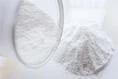

The right silica carrier for pesticides is the grade that holds the required total liquid phase and still meets the powder's next job. Start with kilograms of active, solvent, and liquid co-formulants per kilogram of dry silica; then test the loaded powder for surface dryness, flow, compaction bleed, dust, and storage stability. For WP or WG/WDG products, approval must also include wetting, dispersion, suspensibility, sieve residue, or granule breakup as applicable. A high DBP or oil-absorption value can shortlist a porous silica, but it does not predict the safe loading of a specific oily active or guarantee release in water.
Four decisions before requesting samples
Define the entire liquid phase, not active ingredient content alone.
Set a dry-powder endpoint: flow, discharge, dust, and no visible bleed after conditioning.
Specify the route: direct powder, WP, or WG/WDG granulation.
Approve the complete formula after storage and water-performance testing.

Select a Silica Carrier for Pesticides by the Required End State
A carrier that looks dry in an open beaker may still bridge in a hopper, release oil under bag pressure, or interfere with dilution. Use the decision table below before comparing TDS values. For a broader map of carrier, flow-aid, anti-caking, and formulation-support functions, use the silica for agrochemical powders application page.
| Observed need or result | Decision | What must be verified next |
|---|---|---|
| High liquid demand; powder must remain free-flowing | Shortlist porous grades; reject loads that cause smear, bridging, or unstable discharge. | Real-liquid loading ladder, flow, density, dust, and discharge. |
| Dry immediately after mixing, sticky after bagging or warm storage | Reduce loading, change carrier structure, or revise the liquid package. | Compacted conditioning with defined load, time, temperature, and liner. |
| Loaded powder will be sold or milled as WP | Approve only after applicable wettability, suspensibility, and wet-sieve tests. | Use the intended surfactants, water, milling, and product specification. |
| Loaded powder feeds WG/WDG production | Select on granulation and water breakup as well as loading. | Strength, attrition/dust, moisture, breakup, suspensibility, and sieve residue. |
| Active is low-melting, moisture-sensitive, volatile, or chemically reactive | Run compatibility and temperature studies before carrier optimization. | Assay/recovery, impurities, moisture, heat history, and packaging. |
Calculate the Load on the Total Liquid Phase
Define R = mass of total liquid phase ÷ mass of dry silica, in kg/kg. Total liquid phase includes active, solvent, oil, liquid surfactant, and other liquid co-formulants. Record temperature, polarity, viscosity, density, water content, volatility, and relevant melting or cloud point. These variables affect distribution, surface dryness, and later migration. The practical endpoint is a formulation result, not a pore-volume calculation.
Do not confuse three levels of evidence
Raw-material data shortlist the silica. Process data show whether liquid distributes evenly. Finished-product data establish flow, storage, water performance, and active recovery. BET, purity, particle size, or absorption alone cannot replace these results.
DBP or Oil Absorption Is a Screening Index-not the Actual Liquid Limit
An absorption number needs its method, test liquid, units, endpoint, and conditioning. ISO 19246:2016 uses DOA in an absorptometer and relates the result to void volume in silica aggregates and agglomerates. Its scope is rubber-compounding silica, not pesticide loading.
Do not directly rank DBP, DOA, and manual oil values. Compare candidates with the real liquid under one procedure and leave margin for compression, heat, vibration, and time.
Control Addition Order, Distribution, and Surface Dryness
Compare metering liquid into a dry carrier bed with adding a compatible premixed liquid phase. Hold fill, speed, temperature, addition time, and post-mix time constant; fast pouring can create local saturation.
"Dry to the touch" is only an initial observation. Record wall adhesion, lumps, smear, defined-orifice flow, and discharge, then condition a sealed sample under documented compression and temperature.
Run candidate silicas side by side with the same liquid, loading ladder, mixer settings, and storage conditioning. The image is illustrative; publish test results only with the method and batch identification.
Find the Usable Liquid Load from Three Endpoints
No single kg/kg value can be transferred safely from one pesticide liquid to another. Build a loading ladder with the actual active, solvent, and liquid co-formulants. Hold the liquid lot, silica mass, mixer, fill level, addition rate, temperature, and conditioning constant. Record both the last passing level and the first failing level for each endpoint below.
| Endpoint | Controlled observation | Purchasing decision |
|---|---|---|
| Free-flow endpoint | After a fixed rest period, measure discharge through the chosen funnel, orifice, or small hopper and record bridging or wall adhesion. | Sets the maximum load that remains processable in the selected handling system. |
| Surface-dry endpoint | Inspect for free liquid, gloss, smear, mixer-wall coating, and soft agglomerates at a fixed time after mixing. | Sets the maximum load suitable for clean transfer, filling, and immediate handling. |
| Compacted-storage no-bleed endpoint | Condition a sealed sample under defined pressure, temperature, and time; inspect for oil stain, gloss, cake, and lost discharge. | Sets the storage-safe maximum for the intended bag, stack, warehouse, and transport conditions. |
Decision rule: use the lowest of the three endpoints as the ceiling, then set the working load below it with a documented process margin. Confirm WP wetting and suspensibility or WG/WDG breakup and suspension performance at that lower load. DBP, DOA, BET, particle size, or purity cannot substitute for any of these formulation endpoints.
For WP or WG/WDG, use the current method for the formulation and target market. The 2025 FAO/WHO pesticide-specifications manual calls for appropriate standardized methods. CIPAC MT 53.3 and MT 184 are wettability and suspensibility examples; the applicable product specification controls the current method and limit. Check the WHO formulation templates.
Wetting, Suspension, and Release Depend on the Full Formulation
A free-flowing loaded powder may still wet slowly; a fast-wetting powder may still settle. Treat carrier, wetting agent, dispersant, binder, milling, and water quality as interacting variables.
Define rapid release, stable suspension, or granule breakup as the endpoint. Measure active recovery where feasible; cloudiness does not prove release. Re-optimize surfactant level or order after changing the carrier.
Failure Symptoms and Corrective Direction
| Failure symptom | Likely direction to investigate | Next action |
|---|---|---|
| Sticky during addition | Local over-wetting or poor distribution. | Stage the liquid and repeat before changing grade. |
| Dry initially; oily or caked after storage | Insufficient loading margin or compression-induced migration. | Lower the ratio or change structure; repeat conditioning. |
| Good dry flow; poor wetting | Poorly distributed surfactant or excessive surface to wet. | Screen surfactant type, level, and order. |
| Wets quickly; settles or leaves sieve residue | Dispersion, milling, size, or density mismatch. | Review dispersant and milling first. |
| Excess dust or poor volumetric feeding | Particle form or density does not suit the plant. | Compare densified/agglomerated forms and recheck performance. |
| WG/WDG is hard or slow to break up | Carrier changed binder/water demand or drying. | Rebalance binder, water, drying, and disintegrant. |
When Carrier Silica Is-and Is Not-the Right Route
Appropriate: the liquid can be loaded with storage margin, the active remains stable, and the finished WP or WG/WDG meets its water-performance specification.
Reformulate when: the load bleeds, package volume is impractical, the active degrades or binds irreversibly, or water release cannot be restored. Alternatives include revising the liquid package, changing carrier class, encapsulation, or a liquid formulation; each requires fresh evaluation.
Qualify the Supplier Documents Before the Plant Trial
A TDS screens the grade; a COA reports a named lot against the raw-material specification. Three independent lots are more informative than three bags from one lot, but consistent documents still cannot prove formulation performance.
| Purchasing check | Minimum evidence to request | Decision if evidence is unclear |
|---|---|---|
| Document identity | Current TDS and SDS revision, exact grade name, COA lot number, production date, and COA date. | Hold qualification until the grade and lot are traceable across all documents. |
| Physical identity | Particle size or distribution with method and unit, physical form, and loose bulk density with the filling procedure. | Do not compare values obtained by different methods or assume powder and densified forms will feed alike. |
| Condition-sensitive results | Moisture or loss on drying with temperature and time; pH with suspension concentration and medium. | Normalize the method or retest before judging lot-to-lot drift. |
| Absorption index | Test liquid, method, unit, endpoint, and sample conditioning for DBP, DOA, or another reported index. | Use it only to compare raw-material lots tested on the same basis; do not convert it into an active-loading claim. |
| Sample traceability | Trial sample lot linked to its COA and retained-sample reference; preferably three independent-lot COAs for initial consistency review. | Do not approve a commercial grade from an untraceable sample or pass/fail statements without measured values. |
Hold release when documents use unmatched methods, units, bases, or physical forms; the sample is not traceable; or the SDS does not match the grade. Documents do not replace the real-liquid trial or finished-product specification.
For sample comparison, review the pesticide carrier silica and an alternative agricultural carrier grade. Release purchasing against the agreed specification, traceable sample, and formulation results.
Request a Liquid-Loading Sample Trial
Submit the active's physical state, the complete liquid-phase percentage, WP or WG/WDG route, target powder flow, mixer and packing conditions, storage conditions, and required water behavior. Request a grade comparison and samples for a controlled loading trial.
Send Formulation Details and Request SamplesFrequently Asked Questions
How much liquid can precipitated silica carry?
There is no transferable universal value. The usable load is the highest ratio that preserves the defined fresh-powder, compacted-storage, process, and end-use results with manufacturing margin. Determine it with the actual total liquid phase; do not convert a DBP or DOA value directly into a formulation dose.
Which silica is suitable for oily pesticide actives?
Start with a porous precipitated-silica carrier whose documented physical form, density, absorption method, and dust profile fit the plant. The suitable grade is the one that passes real-oil loading, compression/storage, active-recovery, and applicable WP or WG/WDG tests.
Why does a silica carrier powder become sticky?
Common causes are localized over-wetting, insufficient pore or surface margin at the chosen load, temperature-related viscosity change, and liquid migration under vibration or compression. Confirm whether stickiness occurs during addition or only after conditioning; the corrective action is different.
Technical Sources Reviewed
- WHO. Manuals on Development and Use of FAO/WHO Specifications for Pesticides, 2025 third edition. https://extranet.who.int/prequal/vector-control-products/manuals-development-and-use-faowho-specifications-pesticides
- FAO. Specifications for Pesticides: A Training Manual (official training material; includes WP/WG examples for CIPAC wettability and suspensibility methods). https://www.fao.org/fileadmin/templates/agphome/documents/Pests_Pesticides/eng_Participant_guide_pesticide_specification.pdf
- WHO. Formulated Chemical Product Specification Templates. https://extranet.who.int/prequal/vector-control-product/document/formulated-chemical-product-specification-templates
- ISO. ISO 19246:2016-Rubber compounding ingredients-Silica-Oil absorption of precipitated silica. https://www.iso.org/standard/64133.html
- JK SILICA. How to Read a Precipitated Silica TDS and COA Before Qualification. https://www.jksilicas.com/info/how-to-read-precipitated-silica-tds-coa-103618802.html
Technical note: This page supports raw-material screening and formulation planning. It does not replace product registration requirements, an approved pesticide specification, plant safety review, or testing of the complete formulation in the target market.