


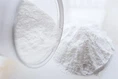
The right silica carrier for choline chloride is the grade that holds the required amount of solution while the finished powder remains surface-dry, uniform, free-flowing, and stable in its final package.
Start with the choline solution assay and target powder assay. Calculate the available carrier mass, then run a loading gradient using the actual solution at its normal feed temperature. Final approval should be based on flow after rest, assay uniformity, caking, liquid release, bulk density, and storage performance.
How to Select a Silica Carrier for Choline Chloride
| Bench-test result | Selection result | Next action |
|---|---|---|
| Surface stays dry and flow remains acceptable after rest and storage | Loading point can move to production verification | Check assay uniformity, packaging volume, discharge, and initial production lots. |
| Powder looks dry after mixing but forms hard cakes during storage | Immediate absorption is acceptable; storage margin is insufficient | Reduce loading, test another pore structure, or improve the moisture barrier. |
| Wet specks, mixer-wall buildup, or liquid release appears | Practical loading is exceeded or liquid distribution is poor | Lower the loading and review addition rate, spray pattern, and mixing intensity. |
| Flow is acceptable, but bag volume is too high | Carrier bulk density or finished-powder density is too low | Compare microgranular silica, a denser grade, or a plant-based carrier. |
| Bulk sample passes, but bag-to-bag assay varies | Liquid distribution or sampling does not represent the batch | Revise the addition sequence, mixing time, discharge control, and sampling plan. |
Calculate Carrier Demand from the Target Active Content
Define A as the mass fraction of choline chloride in the liquid, T as the required mass fraction in the finished powder, and P as the target batch mass.
Required choline solution mass = P × T ÷ A
Mass remaining for silica and other dry ingredients = P − required solution mass
For example, a 70% solution used to make a 50% active powder requires 0.714 kg of solution per 1 kg of finished product. This leaves 0.286 kg for silica and any other dry material, assuming no material or water is removed. The calculated liquid-to-remaining-dry-material ratio is 2.5:1.
This calculation is not a formula recommendation. Drying, evaporation, process loss, secondary flow aids, and final moisture targets change the mass balance. Confirm the finished assay and moisture after processing. A "50% choline chloride powder" and a "50:50 solution-to-carrier blend" describe different formulas.

Carrier testing should use the actual choline chloride solution and normal production temperature.
The Same Assay Can Behave Differently in the Mixer
Record solution assay, water content, density, viscosity, temperature, pH when relevant, and visible crystallization or suspended material. Temperature changes viscosity and distribution, while water carried into the powder affects caking and storage stability.
Use normal production liquid rather than a diluted laboratory substitute. If the liquid condition changes between seasons or suppliers, include those limits in the carrier qualification.
What to Measure During a Loading Gradient
Actual Liquid Loading
Test several adjacent loading points around the mass-balance requirement. DBP or oil-absorption data may help screen grades, but it cannot replace testing with the choline solution.
Surface Dryness
Check for wet spots, wall deposits, hand pressure release, and surface change after a defined rest period. Record the endpoint instead of relying on appearance during mixing.
Flow and Caking
Measure discharge, bridging, sieve lumps, and flow after storage. For cohesive bulk solids, stored-flow behavior can be evaluated through shear testing such as ASTM D6128-22.
Particle Size and Density
Match the finished powder to feeders, premix particles, and packaging. Loose and tapped bulk density also help estimate bag volume; ASTM D7481-18 describes these measurements.
Assay Uniformity
Sample different mixer and discharge locations. Compare choline assay and moisture, then confirm that the sampling and sample-preparation procedures represent the batch.
Storage Margin
Repeat surface, flow, caking, density, and assay checks after exposure in the intended sealed package under the destination's temperature and humidity profile.
Addition Sequence and Absorption Endpoint
- Condition and weigh the carrier. Record carrier lot, moisture, particle form, and bulk density.
- Start uniform carrier movement. Confirm the mixer reaches all zones before introducing liquid.
- Add the choline solution gradually. Use a controlled stream or spray pattern that avoids local flooding and mixer-wall contact.
- Allow redistribution. Continue mixing long enough for wet specks to disappear without applying unnecessary shear that breaks granules or increases dust.
- Rest before release. Recheck surface dryness, flow, and liquid release after the powder has equilibrated.
- Add other dry materials according to the validated process. Confirm that the order does not dilute a wet zone, damage uniformity, or hide an unstable loading point.
Failure Symptoms and Corrective Checks
| Failure symptom | Likely cause | Corrective check |
|---|---|---|
| Wet granules or liquid at the bag bottom | Loading exceeds retention margin or liquid distribution is uneven | Reduce loading and review spray pattern, addition time, and mixer coverage. |
| Powder flows initially and cakes after storage | Water migration, hygroscopic pickup, compression, or weak packaging barrier | Test lower loading, another carrier structure, and the final package under expected conditions. |
| High assay variation | Local liquid flooding, short mixing, segregation, or poor sampling | Sample multiple locations and revise addition, mixing, discharge, and sampling procedures. |
| Excess dust or poor feeder behavior | Carrier particle form is too fine or granules are breaking under shear | Compare particle forms and repeat the trial using production-scale shear. |
A Dry Mixer Sample Can Still Fail in the Warehouse
Choline chloride powder should be evaluated in the intended bag and liner. Record seal quality, moisture barrier, fill volume, headspace, vibration, stacking pressure, warehouse temperature, humidity, and storage duration.
After storage, inspect the top, center, and bottom of the package for caking, liquid migration, density change, and assay variation. Use representative lot sampling and sample preparation; ISO 6497:2002 and ISO 6498:2012 provide relevant feed sampling and test-sample guidance.

Final carrier approval requires the packed powder to remain within the agreed flow, caking, and assay limits.
Silica Carrier vs. Corncob Carrier
| Procurement need | Direction to test first | Trade-off to verify |
|---|---|---|
| Higher active content with less carrier mass | High-absorption silica carrier | Bulk density, dust, package volume, and total silicon dioxide in complete feed |
| Coarser particle profile or plant-based carrier preference | Corncob carrier | Liquid capacity, carrier mass, moisture, microbial specification, particle variation, and storage caking |
| Lower dust and stronger gravity flow | Microgranular silica or appropriately sized corncob | Granule breakage, assay uniformity, segregation, and feeder compatibility |
| Lowest delivered formulation cost | Compare both carriers at the required active content | Include carrier quantity, packaging, freight, handling, yield, rework, and storage loss. |
Silica is unsuitable when the required mass balance exceeds its validated storage-stable loading, the destination market or customer specification does not accept the carrier, or the plant cannot control dust and feeding. Corncob is unsuitable when its required mass prevents the target active content, its particle profile causes segregation, or its moisture and biological specifications cannot be controlled.
Regulatory Basis Must Match the Destination Market
In the United States, 21 CFR 582.5252 lists choline chloride as generally recognized as safe when used according to good manufacturing or feeding practice. 21 CFR 573.940 recognizes silicon dioxide as a carrier in feed ingredients, intermediate premixes, premixes, supplements, concentrates, and complete feed. It also states that silicon dioxide from all sources cannot exceed 2% by weight of the complete feed. This complete-feed basis should not be confused with the carrier percentage in a concentrated choline chloride powder.
For the European Union, verify the current authorization and conditions for choline chloride code 3a890 through the European Commission Food and Feed Information Portal. Confirm the status and specifications of the selected carrier for the destination market before commercial approval. Supplier recommendations do not replace regulatory review.
Product Directions for Sample Screening
Use the feed-grade silica page to request available specifications, documentation, and samples for initial qualification.
Review the micro-bead feed silica direction when dust, flow, bulk density, or granule handling affects the process.
Consider a flow-aid silica when the main carrier already holds the liquid and the remaining problem is finished-powder flow or caking.
For broader selection across liquid carriers, dry premixes, anti-caking grades, and feed-powder applications, use the feed additives and premixes application guide.
Information to Request Before Purchasing
Submit the Solution and Finished-Powder Targets
Send the choline chloride solution concentration, target active content, normal liquid temperature, mixer type, required particle form, package size, storage conditions, and destination market. Request suitable carrier grades, available technical documents, and samples for a loading-gradient test.
Request a Choline Carrier TestFrequently Asked Questions
Which silica carrier is used for choline chloride?
A porous feed-grade precipitated silica with validated liquid capacity, suitable particle form, and acceptable bulk density is the normal starting direction. Select the final grade through testing with the actual choline solution and finished-powder requirements.
How do I keep choline chloride powder free-flowing?
Keep the liquid loading below the storage-stable endpoint, distribute the solution evenly, allow sufficient absorption time, control particle form and density, and use packaging that limits moisture entry. Recheck flow after storage rather than releasing the batch from immediate mixer appearance.
Does a higher DBP value guarantee more choline solution loading?
No. DBP measures absorption under a defined test using a different liquid. Choline solution contains water, has its own viscosity, and may behave differently during storage. Use DBP for preliminary screening and confirm loading with the actual solution.
Is silica carrier better than corncob carrier?
The answer depends on target active content, powder density, particle size, dust control, cost, customer preference, and destination-market requirements. Compare both carriers at the same finished assay and storage conditions.
Last technically reviewed: August 17, 2026